
Ask any CEO, CFO, or HR leader how they feel about the annual health plan renewal meeting, and you will hear some version of the same answer: they dread it. It is the meeting where someone walks in with a slide that shows a number, the number is bigger than last year, and the conversation that follows is mostly about which lever to pull to absorb the hit. Raise the deductible. Shift more to the employees. Switch insurance carriers or vendors. Repeat next year.
That is not a strategy. That is damage control. And it has been the default for so long that many leaders no longer realize there is another way to run the conversation.
There is. It starts by giving leadership a tool that does what the renewal spreadsheet cannot: show them, on a single page, the specific components of their health plan they can actually work on to build a real strategy.
Why the Renewal Meeting Feels Like Bad News
The renewal meeting is painful because it almost always arrives as a verdict, not a working document. By the time the numbers hit the table, the levers available to leadership are narrow, the timeline is short, and the conversation is framed around what to give up rather than what to build. CEOs and CFOs are being asked to approve a cost increase on one of their top three expenses with very little visibility into why the number is what it is or what could move it next year.
The reason that visibility is missing is structural. The traditional benefits process was never designed to give the C-suite a strategic view of the plan. It was designed to deliver a quote. That is a very different thing.
What a Plan Grader Changes About That Conversation
An independent plan assessment like the Health Rosetta Plan Grader does not replace the renewal. It reframes it. Instead of one number arriving once a year, leadership gets a structured, third-party scorecard of the health plan across the four categories of risk that quietly drive cost and exposure all year long:
- Medical risk the clinical exposure inside your population, including how chronic conditions, specialty drug spend, and outlier claims are being identified and managed.
- Member engagement risk whether your employees actually understand, trust, and use the plan you have built. A great plan design that no one uses is a wasted investment.
- Organizational and member financial risk how cost is allocated between the organization and the employee, where stop-loss sits, and whether the financial structure can absorb a bad claims year without forcing a benefit cut.
- Legal and fiduciary risk fiduciary obligations under ERISA, CAA compliance, fee transparency, and the rising wave of plan sponsor lawsuits that belong on every CEO, CFO, and HR leader’s radar in 2026.
Each of these categories used to live in a different silo, reviewed by a different vendor, on a different timeline. A proper assessment pulls them onto one page so leadership can see how they interact, because in real plans, they always do.
Eight Components You Can Actually Build Strategy In
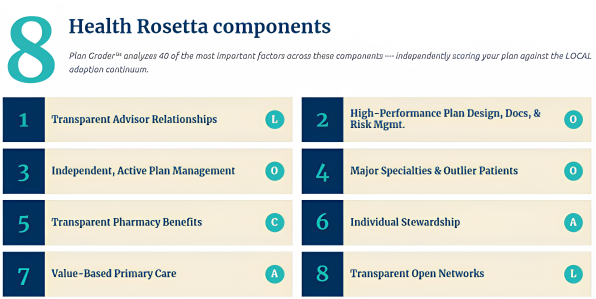
The most valuable thing a Plan Grader assessment does for a leadership team is name the moving parts. The framework is built on the Health Rosetta’s eight components, modeled on hundreds of high-performance employer plans. Each component is a place where a CEO, CFO, and HR team can make a real, measurable decision: how the advisor is paid, how the plan is designed, how it is actively managed, how members are stewarded through care, how primary care is structured, how the network is built, how high-cost claims are handled, and how pharmacy is contracted.
Once a plan has been scored against those eight components, the conversation shifts. Leadership is no longer staring at one number. They are looking at a map. Some components are already strong. Some are average. One or two are usually quietly costing the organization a significant amount of money every year. That map is what strategy is built from.
What This Looks Like Around the Leadership Table
If your last renewal meeting felt like bad news that everyone had to absorb, that is not a sign your team failed. It is a sign the tool on the table was not built for strategy. The employers who are pulling ahead on cost, member experience, and fiduciary protection are the ones who stopped letting the renewal cycle define the conversation and started measuring their plan against something objective.
That is the work the Plan Grader was designed to do, and it is the conversation The Kirsch Group is proud to bring to the HRAM community. If you would like a complimentary Plan Grader report, please contact Cara Kirsch at ckirsch@kirschgroupins.com.

About Cara Kirsch
Cara Kirsch is the Founder of The Kirsch Group with nearly 30 years of experience helping employers with employee benefits, insurance planning, and smarter long-term solutions.
Meet Cara Kirsch